In my home, we celebrate Dinner with the Dead each Halloween. Our feast includes Ancestors from this lifetime and others as well as a few Folk who may not be as clearly related but are nevertheless dear to me. We honor our departed guests using a patchwork of traditions. The celebration changes a bit each year, just like life offers up changes from year to year.
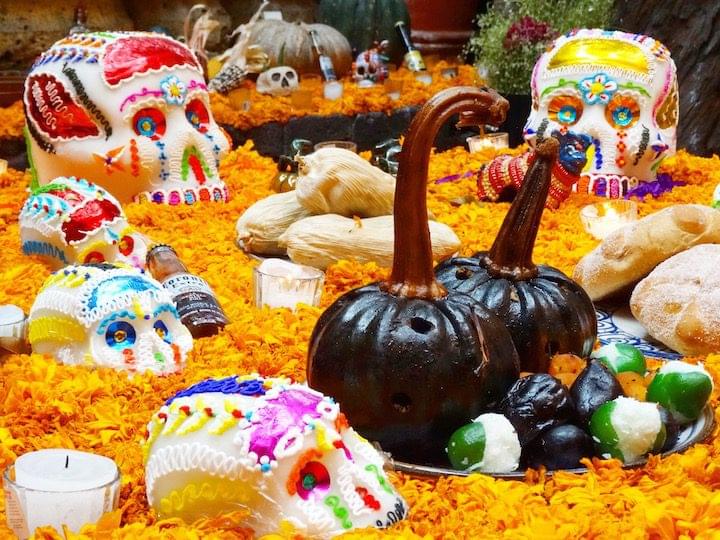
Last year, I had a request for a few Mexican traditions. I added marigolds and pan de muerto to our altar. It wasn’t enough. I wanted to make those beautiful sugar skulls called calaveras, too. Sadly, the Pacific Northwest is a damp place in the fall. Those skulls need a good, dry climate to cure properly.
This recipe is a good place to start, if you want to learn how to make Cavaleras right. The first step is to make a dough with two or three cups of sifted powdered sugar, a Tablespoon of corn syrup, an egg white, and a dabble of vanilla extract then shape the skulls. They need to dry really well. It will probably take a week even in the bone-dry weather of my PNW summers. Once they’re completely dry, set them in a sealed container in the refrigerator to protect them from both humidity and the ants until the day of celebration.
Just before Dia de los Muertos, finish by making some thick, colored icings and decorating your cavaleras. Traditionally, you decorate one for each of the ancestors whose names you know. I always add a few for those who are related in some other way or come from some other lifetime. In my home, making Cavaleras is a true Celebration of Life.
Traditional Cavaleras Recipe
Work in a clean, dry area. Keep the sifter and powdered sugar handy as you work just as you do with flour when making bread. Sift and add more sugar to the dough as you’re kneading and shaping it so it doesn’t stick to your hands or the counter.
Ingredients for Cavaleras
- 2-3 cups (475-710 ml) sifted powdered sugar
- 1 Tbsp. (15 ml) corn syrup
- 1 egg white
- 1/2 tsp. (2-3 ml) or so vanilla extract
Tools
- Mixing bowl
- Measuring cups and spoons
- Sifter and bowl for sifted sugar
- Spoon or small whisk
- Drying rack or shallow dish
Procedure
- Sift the sugar.
- Separate the egg white from the yolk and put the white in a bowl.
- Add the corn syrup and vanilla extract.
- Whisk well.
- Add the powdered sugar a spoonful at a time, mixing well as you go.
- When the mixture becomes too thick to stir, use your hand to mix it, continuing to add sifted powdered sugar until it’s kneadable. It’s ready when it’s like a soft dough or play dough. You should be able to press your finger into it and see a depression afterward. It shouldn’t crack or stick to your finger.
- Divide the dough into the number of cavaleras you want to make. Nine to eleven is a good number. The larger they are, the longer it’ll take for them to dry. The smaller they are, the harder they’ll be to decorate later.
- Roll each dough ball in a bit of powdered sugar if needed as you’re shaping your skull.
- Shape each skull by rolling a small ball, then lightly pinching the sides on the lower half to form the jaw. Press a small depression for the eyes and nose. Use a toothpick or bamboo skewer to etch in the teeth.
- Set the shaped skulls on a fine mesh drying rack or in a paper towel-lined shallow baking dish to dry. Depending on your climate, it may take a week or more for them to dry thoroughly. If you’re in a rush, you can use a food dehydrator on a lower heat setting. If the heat is set too high, they’ll dry too fast and may crack.
Storage and Use
You can make this dough and store it in a plastic bag in a cool, dry place like the refrigerator. Add more sugar or a few drops of corn syrup to adjust the consistency as needed when you’re ready to use it.
Store dried cavaleras in a sealed container. The refrigerator or freezer are good choices if you have sugar ants in your neighborhood. It’s wise to store them in a single layer as well to prevent them sticking should any moisture get into the container.
Decorate them with the same thick colored icing you use for decorating cakes or cookies. Make it by mixing powdered sugar, food coloring, and a tiny amount of water or corn syrup until you have a colored, workable icing. You can use an icing cone or a plastic sandwich bag with one corner tip cut off to apply the icing. You can write the name of a beloved Ancestor on the forehead of each one if you’d like to be traditional.