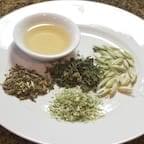
The schisandra berry is a delightful, and delicious, addition to an herbalist’s toolkit. Before I describe in detail all the abilities and applications of this herb, I want to share my personal experience of schisandra.
When I was in high school, I began seeing an acupuncturist for treatment of Tourette’s Syndrome. Like many other people, I came to Chinese medicine as a patient when Western medicine had failed to help. I found pharmaceutical therapies overpowering and with side effects that were often worse than my symptoms. Constitutionally, I needed an approach that was more subtle and gentle. One of the first herbal therapies my acupuncturist used with me was encapsulated granular schisandra. Not every patient needs to be hit over the head with a mallet, some folks just need a little nudge. (For the mallet patients, use aconite.)
What is Wu Wei Zi?
The Chinese name for schisandra is Wu Wei Zi, which means “five flavor seed.” In Chinese medicine, there are five broad categories of flavor: sweet, sour, salty, bitter and acrid. Each of these flavors corresponds to particular actions in the body. Wu Wei Zi is one of the rare herbs that is believed to contain all five flavors. As such, it has a broad range of applications both as a single herb and in herbal formulas.
As a single herb, schisandra’s most powerful ability is that it “quiets the spirit.” It does this by astringing, or containing, the Qi of the Lungs. The Lungs are the organ most vulnerable to grief. When a person has been hit with loss and is having trouble processing and coping with their loss, the Qi of the Lungs is said to “leak” out, leaving the person both drained and agitated.
Schisandra as an Astringent
All sour herbs have the ability to astringe something, usually fluids of some kind. Schisandra can do that too, and is thus a useful herb for the treatment of diarrhea. (Raspberries are good for this as well.) Schisandra takes that powerful holding action deeper into the body and it contains not only fluids but also Qi. This makes schisandra a poor choice for a person who is in the early stages of a cold. At that point, we do not want to trap the Qi of the pathogen in the body, we want to vent it out. So before recommending schisandra to a patient (or taking it yourself) make sure the person is not coming down with a cold or having seasonal allergies. Schisandra, especially in large doses, could make it worse.
Schisandra for Chronic Cough
What is a little bit confusing about this, is that schisandra is actually an excellent herb for treating a chronic cough, wheezing or asthma, as it powerfully strengthens the Lungs. So if someone is coughing a lot, we have to differentiate between a recent onset cold or allergies and an on-going, chronic lung problem. If the person is frail, has a deep mid-line crack in their tongue and their pulse is weak, then schisandra is the way to go, usually in combination with other herbs. If the person is robust, has a ruddy complexion, is doing more sneezing than coughing, and they have a strong pulse that you can feel on the surface of the skin (without applying any pressure), then schisandra would be contraindicated.
Schisandra not only strengthens Lung Qi it is also said to “tonify the Kidneys.” This is really just another application of schisandra’s astringing or containing ability. In the Kidney’s it is said to “bind up the essence,” which is a polite way of referring to various fluids associated with reproduction. Schisandra prevents nocturnal emotions, watery vaginal discharge and urinary incontinence. Here we see again how schisandra holds fluids in the body. Schisandra will also inhibit sweating, though usually only in combination with other herbs.
Schisandra for Insomnia and Sleep Disturbance
The most common reason I use schisandra is for treatment of insomnia. It is specifically used for dream-disturbed sleep or insomnia that results from Blood and Yin Deficiency in the Heart. Again, we see the pattern: where fluids (Yin is considered a fluid-like substance) are leaking out or being lost, schisandra helps to retain and contain those fluids.
Chinese medicine teaches that the spirit of the Heart lives in the Blood. When the Blood is deficient, the spirit has no home and it goes wandering. Think of the spirit as a duck that needs a pond to paddle around in. If the pond goes dry, the duck wanders off, quacking in distress. This creates symptoms like agitation, heart palpitations, dream-disturbed sleep, and insomnia. Over time, this condition can lead to memory issues as well.
Properly dosed, schisandra works to essentially plug up the holes that are causing the leaks. Once everything has been shored up, and the fluids are where they belong, the body heals on its own. For this reason, schisandra does not need to be taken over a long period of time. If the patient’s symptoms improve, they can stop taking the herb.
Schisandra in Common Formulas
Schisandra shows up in a lot of common formulas that you will see in commercial preparations. It is used in Xiao Qing Long Tang, or Minor Blue/Green Dragon Decoction, for chronic cough and wheezing where cold, thin mucus is present. It used in San Piao Xiao San or Mantis Egg-Case Powder to treat spontaneous seminal emissions. There is also Si Shen Wan or Four Miracle Pill which treats “day break diarrhea,” or diarrhea that comes first thing in the morning.
The two schisandra formulas I use the most are Suan Zao Ren Tang, which is the classic insomnia formula; and Tian Wang Bu Xin Dan, or Emperor of Heaven’s Special Pill to Tonify the Heart. Tian Wang Bu Xin Dan is a legendary formula that supposedly came to a scholar in his sleep. The poor young man was studying for the Imperial Exams but his memory was terrible and he feared that he would fail. In a dream, this formula was revealed and he was able to memorize it in time. When he woke up, he wrote it down. And now we have this formula which is specifically used to improve memory and to this day is something people will take when they are sitting for exams.
The larger picture behind schisandra is that on both a physical and a spiritual level it contains and rebuilds in the wake of loss. Whether that loss takes the form of physical leakage of fluids (semen, vaginal secretions, urine, thin mucus from the nose, etc.) or a spiritual loss (Yin, essence, spirit, etc.), schisandra gently guides a person back to holding what needs to be held. Then the person can safely release what needs to be released.